 Sign up


Introducing the ASEAN Green Economy Landscape 2026
Padang & Co created the first Landscape in 2024 to spark conversations and highlight actionable opportunities for the startups, scale-ups and SMEs building Southeast Asia's green economy. This is our third edition (September 2026) and now includes a directory of all 1,148 featured startups and SMEs.
Much of the research on Southeast Asia's green economy speaks to governments, multilateral institutions and large corporates. But innovation often happens outside the biggest organisations, in new technologies, new business models, new ways of financing, and new partnerships connecting markets. Startups and SMEs are where much of that innovation takes place. Our goal is to help them see where they fit and even where they can lead.
Our thinking has evolved with each edition: from sustainability mindset in 2024, to abundance in 2025, to resilience in 2026 -- the lens we apply to each Landscape. It is also where startups, scale-ups, and SMEs matter: closer to the ground and quicker to adapt, they are well placed to turn disruption into opportunity.
2026, Year of Resilience
UNEP's latest assessment confirms global warming will breach 1.5°C within the next few years. For a region that contributes least to climate change and stands most exposed to it, this is the environment this Landscape was written in. The disruption at the Strait of Hormuz has cut crude exports and raised food security risks well beyond the Middle East, whilst a record Super El Niño is reshaping harvests. Singapore has named 2026 its Year of Climate Adaptation and stated collective resilience as one of its three priorities for the ASEAN chair position in 2027.
Climate Resilience
Capacity of ecosystems and communities to withstand physical shocks (floods, storms, heat, drought, and typhoons). This is adaptation, not mitigation; i.e. more than enabling more clean energy or cutting emissions. Specifically, it is hardening something or someone against a physical shock.
Economic Resilience
Reduced dependence on fragile supply chains and imported inputs. It is not capital mobilisation, capex protection, or trade competitiveness in general. Specifically, it is whether this reduces reliance on something imported or supply chain fragile.
Social Resilience
Whether a transition strengthens livelihoods and community stability, or risks displacing them. Specifically, it is about livelihoods, jobs, and whether communities are stabilised or disrupted.
The 7 Sectors of the Green Economy
Note: Companies with multiple areas of operation are counted across relevant activities and/or industries. As a result, the activity-based totals exceed the primary industry/sector count.
Nature, Agriculture & Food
This sector spans three tightly linked systems: the natural resources everything else relies on (forests, mangroves, reefs and soil); the roughly 100 million smallholder farming households who work that land; and the food security and nutrition of everyone else, which both of those ultimately produce. It is the largest sector in this Landscape with 280 startups and SMEs.
Nowhere else in this Landscape do cutting emissions and building resilience overlap so completely, because these three parts feed into each other. Degraded nature makes farming more expensive. Expensive, precarious farming makes food security more expensive. A stressed food system pushes farmers to clear more land, degrading nature further. Breaking that cycle means building backup capacity, variety, and fair access to funding into all three parts.
- 6 top stories for the sector in 2026
- Relevance of climate, economic, social resilience to each top story
- Opportunity areas for each top story
- Innovation opportunities for startups and SMEs for each opportunity area
Energy Transition
The region’s energy transition is becoming a race between electricity demand and the system’s ability to serve it. Electricity demand is already growing twice as fast as overall energy use and could more than double by 2050. The transition has shifted from a policy problem to a physical one, and increasingly, a resilience one. Significant groundwork has been put in motion, driven by the Enhanced ASEAN Power Grid (APG) MOU was signed in October 2025.
Progress is unevenly distributed. The operating rules needed to connect, balance, store and trade clean power still remain incomplete. Transition costs can be pushed onto smaller consumers. Every other sector's decarbonisation depends on how much redundancy and flexibility the energy system builds in, not just how fast clean power gets delivered.
- 4 top stories for the sector in 2026
- Relevance of climate, economic, and social resilience to each top story
- Opportunity areas for each top stories
- Innovation opportunities for startups and SMEs for each opportunity area
Climate Markets & Enablers
This sector is about getting money to flow into climate solutions. Large Asian institutions, pension funds, insurers, banks, collectively manage US$123 trillion, and they are putting more of it toward climate investments each year while pushing governments for clearer rules. Singapore alone has laid out a plan to help close the US$700 billion global funding gap for protecting and restoring nature.
There are ways to move this money into climate projects, just not enough of them. The system leans on a few mechanisms with no backup if one stalls, so this is about spreading risk as much as raising money.
- 4 top stories for the sector in 2026
- Relevance of climate, economic, and social resilience for each stop story
- Opportunity areas for each top story
- Innovation opportunity areas for startups and SMEs for each opportunity area
Built Environment
Southeast Asia's buildings and cities are on the front line of climate change. The region needs roughly US$184 billion a year in infrastructure spending through 2030 to maintain economic growth and tackle poverty. When climate impacts are taken into account the number increases to US$210 billion.
That investment is not spread evenly. Some countries are already building climate-resilient infrastructure at scale, while others are still working out how to pay for it. New pressures are also exposing how little spare capacity the system has. Demand is increasing for cooling as temperatures rise. The AI boom is exposing where power and water infrastructure were not built to handle rapid growth.
- 4 top stories for the sector in 2026
- Relevance of climate, economic, and social resilience to the sector
- Opportunity areas for each top story
- Innovation opportunities for startups and SMEs for each opportunity area
Transportation & Logistics
Across fuels, vehicles, freight and food logistics, the physical capacity to decarbonise mostly already exists. What is missing varies by segment: certification, financing, infrastructure, or the data to prove compliance.
Many of the technologies and much of the progress made are arriving from outside the region, rather than being built domestically. This dependency is itself a resilience risk. A sector that imports its technology, capital and standards has less control over its own pace of decarbonisation, and has less redundancy.
- 4 top stories for the sector in 2026
- Relevance of climate, economic, and social resilience to the sector
- Opportunity areas for each top story
- Innovation opportunities for startups and SMEs for each opportunity area
Industrial Decarbonisation
The scale of the challenge starts with a blunt fact: Asian fossil fuel and cement producers accounted for nearly a third of global fossil CO2 emissions in 2024, with state-owned coal producers driving most of the increase. Industrial decarbonisation in this region is not a niche problem.
Supply-side solutions are outpacing the demand-side conditions needed to make them commercially viable. Buyers may be willing to pay a premium, and policy that requires buyers or producers to adopt solutions. If a sector cannot generate its own demand and has to rely on external pressure to move, it has little capacity to organise its own transition.
- 4 top stories for the sector in 2026
- Relevance of climate, economic, and social resilience to the sector
- Opportunity areas for each top story
- Innovation opportunities for startups and SMEs for each opportunity area
Circular Economy & Waste
The scale of the opportunity is larger than any single reform. Plastics alone illustrate it: recycling all of Southeast Asia and South Asia's mismanaged plastic waste could cut emissions by more than 200 million tonnes by 2030. More than 75% of the material value of that plastic is lost, the equivalent of US$6 billion a year in Malaysia, the Philippines and Thailand alone.
The sector is shifting from a waste management problem into a resource and safety one. How it navigates that shift, on formal infrastructure, or on an informal workforce it has not protected, will determine how resilient it becomes. In other words, this is a question of inclusion as much as capacity.
- 4 top stories for the sector in 2026
- Relevance of climate, economic, and social resilience to the sector
- Opportunity areas for each top story
- Innovation opportunities for startups and SMEs for each opportunity area
Green Economy Innovation in ASEAN-6 Countries
Companies by country
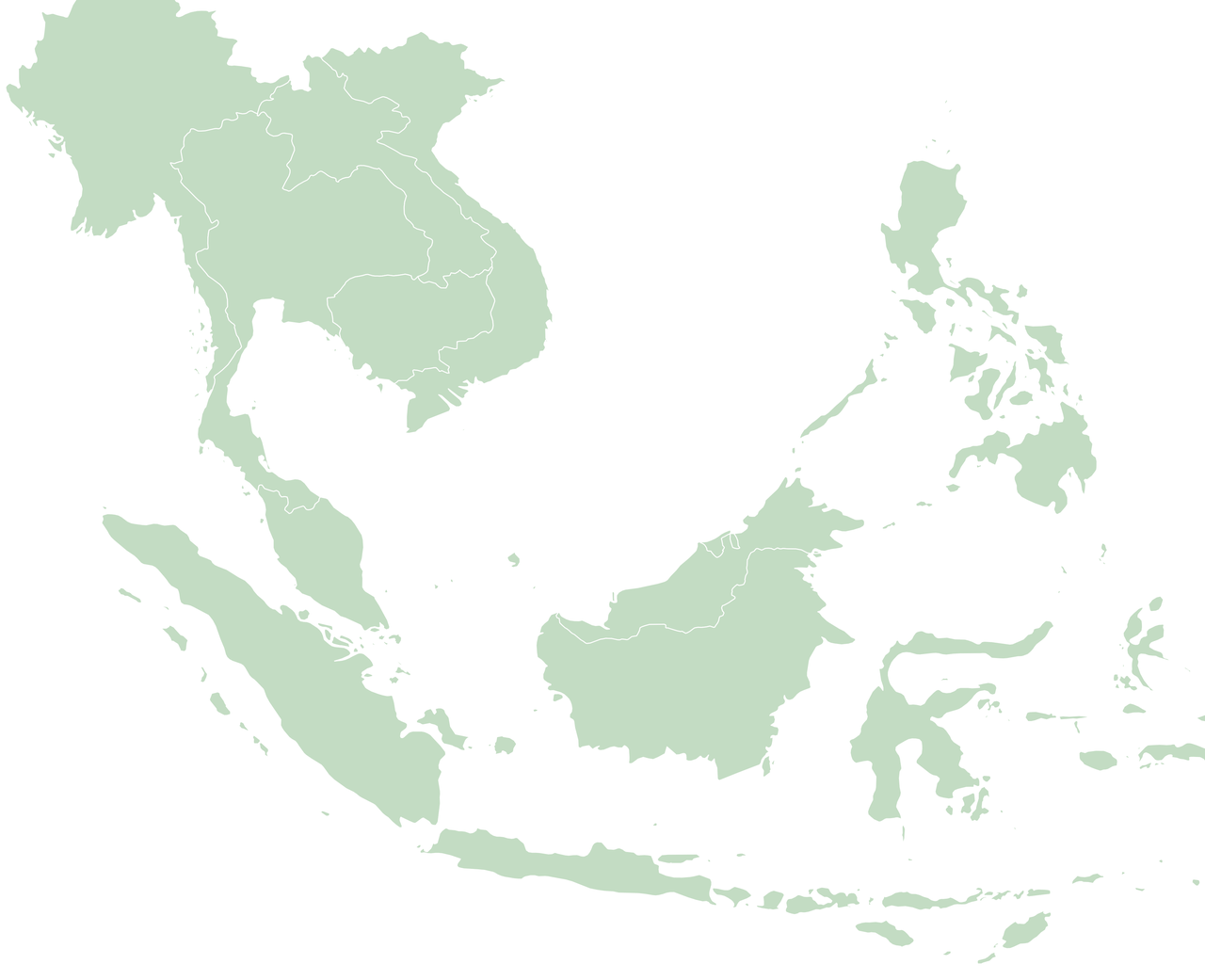
ASEAN-6 · 1,148 total
Singapore
Largest and most diversified ecosystem in the region
Relatively even spread across sectors (from 113 in Nature, Agriculture & Food down to 29 in Industrial Decarbonisation). The region's built environment and climate markets "operating system", hosting half of ASEAN-6's companies in Built Environment (56%) and Climate Market & Enablers (53%). Underweight in transport despite being a logistics hub (37% of ASEAN-6).
Philippines
The only country where Energy Transition is the top sector (not Nature, Agriculture & Food)
12% of ASEAN-6's total in Energy Transition against just a 6% overall share. Climate Market & Enablers (6), Built Environment (5) and Circular Economy & Waste (5) are underrepresented relative to overall share.
Vietnam
Most agri-centric ecosystem
Nature, Agriculture & Food accounts for 39% of companies -- 12% of ASEAN-6's agrifood companies despite only a 7% overall share. The rest of the portfolio is small in absolute terms, but broadly proportional.
Thailand
Strong Industrial and Agrifood Orientation
18% of ASEAN-6's total in Industrial Decarbonisation companies against only a 10% overall share of startups. Nature, Agriculture & Food (32) is largest sector. Broad spread in all other sectors.
Malaysia
Balanced, mid-sized ecosystem
Spread fairly evenly across sectors. Circular Economy & Waste (18% of ASEAN-6) is the one sector that runs above its 15% overall share. Industrial Decarbonisation is the clear gap -- Malaysia's smallest sector (9 companies) by some margin.
Indonesia
Dominated by Agrifood and Mobility
Nature, Agriculture & Food (47) and Transportation & Logistics (30) together account for 42%, reflecting its agrarian base, and urban and archipelagic mobility challenges. Overrepresented in Transportation & Logistics (22% of ASEAN-6) and Circular Economy & Waste (21%) – above its overall share of ASEAN-6. Clear gaps in Built Environment and Industrial Decarbonisation.
Unlock deep-dives into the 7 sectors and 6 countries!
Register to view the directory of all 1,148 startups (searchable and filterable).